

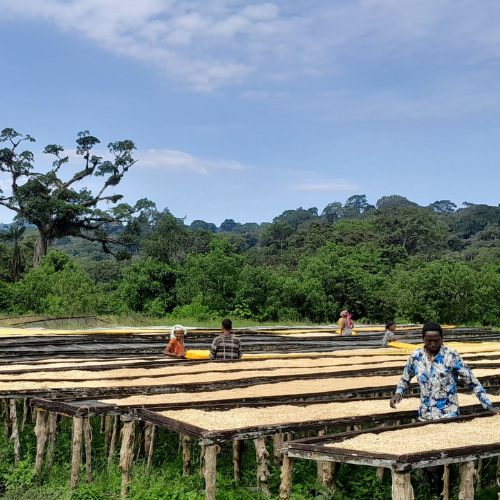
Teppi is an important coffee-producing area in southwestern Ethiopia, located in the Sheka Zone of the South West Ethiopia Peoples’ Region (formerly part of SNNPR). The region lies within Ethiopia’s dense southwestern rainforests, an area internationally recognized for its biodiversity and long association with the natural habitat of Coffea arabica. Coffee in Teppi is typically grown at elevations of about 1,100 to 1,700 meters above sea level, under warm, humid conditions with high annual rainfall and rich forest soils, making it one of Ethiopia’s classic low- to mid-altitude forest coffee zones.
Coffee production in Teppi is dominated by smallholder farmers and forest-based systems, where coffee trees grow under heavy shade from indigenous forest species. Traditional, low-input farming practices are common, and chemical usage is minimal, meaning much of Teppi coffee is effectively organic. The coffee consists mainly of Ethiopian heirloom Arabica varieties, including diverse wild and semi-wild landraces that are genetically valuable and well adapted to the region’s humid environment. Harvesting is done by hand, and both natural (sun-dried) and washed coffees are produced, although naturals have historically been more prevalent due to limited processing infrastructure.
Teppi coffees are known for their soft, earthy, and herbal cup profiles, typically featuring medium body, low to moderate acidity, and flavors of cocoa, malt, dried herbs, spice, and subtle fruit notes. Washed Teppi coffees can show improved clarity and gentle brightness, with hints of citrus peel, stone fruit, and light florals, but the overall profile remains round and mellow rather than sharply acidic. These characteristics have traditionally made Teppi coffee suitable for commercial use and blending, particularly where body and depth are desired.
Despite its rich ecological potential, Teppi has often been underrepresented in the specialty coffee market due to infrastructure challenges, inconsistent quality control, and long market chains. However, increasing attention to forest conservation, traceability, and improved post-harvest practices is beginning to reveal higher-quality expressions of Teppi coffee. As global demand grows for forest-grown, sustainable, and heirloom coffees, Teppi is gaining renewed recognition for its role in preserving Ethiopia’s coffee biodiversity and for offering distinctive, grounded flavor profiles rooted in the country’s southwestern coffee heartland.