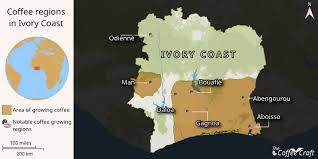
Man, located in western Côte d’Ivoire near the Guinean and Liberian borders, is one of the country’s most significant agricultural hubs and is specifically known for producing high-quality Arabica coffee. The region’s mountainous terrain, fertile soils, and cooler temperatures create ideal conditions for Arabica cultivation—uncommon in a country otherwise dominated by Robusta.
Man is also home to major coffee-processing infrastructure, including a UNICAFÉ factory, Côte d’Ivoire’s national coffee manufacturer, as well as NESLÉ coffee plants, which further support the region’s role in national production, processing, and export. Although Man produces a wide range of crops—such as cocoa, bananas, rice, and vegetables—it remains the largest coffee-producing zone in the country, historically supplying a substantial share of both domestic consumption and export volumes.
Beyond Arabica, the region is notable for cultivating Arabusta, a hybrid of Arabica and Robusta first developed in the 1960s under Côte d’Ivoire’s first president, Félix Houphouët-Boigny. Man served as one of the primary sites for Arabusta experimentation and expansion. The hybrid was designed to combine Robusta’s disease resistance and high productivity with Arabica’s superior flavour profile.
However, despite its potential, Arabusta remains relatively rare in farmers’ fields. The main challenge is its slow growth cycle, which makes it less economically attractive compared to fast-growing Robusta varieties—even though Arabusta trees offer a longer productive lifespan and can deliver excellent quality when properly cultivated.
Today, Man remains a central player in Côte d’Ivoire’s efforts to diversify and improve its coffee sector, offering unique Arabica and Arabusta profiles within a predominantly Robusta-producing nation.