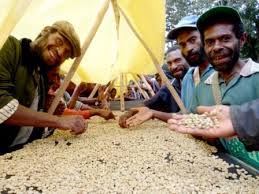
Malaita, one of the largest and most populous islands in the Solomon Islands, has a modest but culturally significant tradition of smallholder coffee cultivation, concentrated mainly in its central and eastern highland interiors. Unlike Guadalcanal, where production is more established, Malaita’s coffee sector remains small, scattered, and largely subsistence-oriented, yet it plays an important role as a supplementary cash crop for rural households.
Coffee is grown primarily in the elevated regions of Central Malaita, East Kwaio, East Fataleka, and pockets of north-central mountain villages, where elevations reach 500–900 meters. These upland areas provide slightly cooler temperatures, better-drained volcanic soils, and partial cloud cover—conditions that support Arabica coffee, the main species grown on the island. Most farms are tiny family plots intercropped with traditional staples such as taro, banana, yam, cassava, and betel nut. Shade trees are common, and management is low-input, reflecting customary agroforestry practices.
Processing methods on Malaita vary depending on the community. In areas with reliable water sources, farmers use simple fully washed methods, depulping cherries by hand or with small pulpers, fermenting in buckets or basins, and drying on mats or tarpaulins. In areas with limited water access, semi-washed or sun-dried natural processing is more common. The resulting coffees typically exhibit soft acidity, light-to-medium body, and mild flavor notes, often with hints of nuts, cocoa, and light fruit.
Malaita’s coffee production faces numerous challenges. Steep and remote terrain makes transport difficult, often requiring long walks to coastal markets. Limited access to pulping machines, drying beds, and training constrains quality, while competition from more profitable crops—such as cocoa, copra, and kava—reduces coffee’s economic appeal. Institutional support has historically been limited, though church organizations, local cooperatives, and rural development projects periodically attempt to revive interest in coffee as a livelihood option.
Despite these constraints, coffee retains social value as a cash-generating crop for inland communities with few market alternatives. With investment in processing infrastructure, cooperative organization, and market connections, Malaita’s upland areas hold potential for producing modest but improved Arabica coffees that reflect the island’s unique agroforestry landscapes and subsistence farming traditions.